Showing posts with label ultras. Show all posts

Monday, 20 November 2017

Great Expectations

“I have been bent and broken, but - I hope - into a better shape.” 
-- Charles Dickens, Great Expectations

It was 5am on the morning of Saturday 14 October, 20 minutes before the mandatory roll call for the Great Ocean Walk ultramarathon. All I needed to do was put on my running gear and walk the five minutes to the start line. Putting on my well-worn shorts, I noticed that one end of the drawstring had disappeared into the waistband.

Somewhat annoyed, I extracted the drawstring (which I really needed because the elastic on these shorts is not what it used to be) and started to re-thread it. I won't go into the details of what followed, but it involved a combination of a safety pin, swearing, a ticking watch, accelerating heart rate and a steak knife. I made roll call without a minute to spare.

So far, my quest to run my second 100km ultramarathon in a more relaxed state than my first was not going well. On the plus side, it hadn't even started yet.

The Great Ocean Walk ultramarathon was celebrating its ninth running.  The race, organised by highly respected race director Andy Hewat, covers the full length of the Great Ocean Walk hiking trail. It stretches from the beachside town of Apollo Bay on Victoria's south coast, to the famous 12 Apostles limestone pillars in the shallows of the shoreline near Port Campbell. It would be difficult to find a more stunning stretch of trail in Australia.

I had entered the Great Ocean Walk, often abbreviated to simply 'GOW', two years after running my first (and to that stage, only) 100km ultra. That debut was at the Surf Coast Century and although I had achieved my stretch target of sub-11 hours in that race, I had not enjoyed it. For some runners, being on their limit for hours on end is the reason why they run these races, but after much contemplation, I decided that wasn't for me.

So, GOW would be about starting conservatively, enjoying the trail, taking pictures and not worrying so much about my time. And there I was at the start line with my heart still racing and trying to calm myself down.

At the start line

The first hour or so of the race was in the dark, headlights bobbing in front of me as I settled somewhere in the second half of the 76 person field (there were also seven relay teams of two, who would complete 55/45km legs). Recent rain had turned sections of the trail into ankle-deep, foul-smelling mud. Soon, the gradient shifted up and we tackled the first climb of the day - the 7km from Shelley Beach to Parker Spur.

I enjoy hills and found myself running up this one at a reasonably comfortable pace. The thought did occur to me to slow down and walk, but I was in a good rhythm, so I decided to keep up my steady jog. I passed a few people as I reached the top of the climb around 16km into the race and began the 5km descent to the first aid station at Blanket Bay.

The descent was reasonably uneventful - more mud, a couple of runners overtaking me (I'm much better going up hills than down) and a very positive outlook. I was a few minutes ahead of where I expected to be and feeling good.

I stopped for a few minutes at Blanket Bay, having a quick chat to the volunteer who kindly re-filled my water bottles. Some complaints from campers the year before meant that support crew were no longer allowed at this checkpoint, so the first point I'd see my one-man crew member Paul would be close to the Otway Lighthouse around 32km into the race.

Near Parker Hill 


Seal Point

By this point, the morning had turned into an absolute stunner. Hardly a cloud in the sky, not too warm and only very light wind. And every few kilometres, a glimpse of a gorgeous coastline. In fact, so frequent did these vistas present themselves, that I found myself not bothering to take pictures of most of them. "Meh, another magnificent view - just like all of the others."

Approaching the lighthouse, and having passed the people who got me on the descent to Blanket Bay, I met Paul on the side of the trail. He told me I was in around 30th place. It was nice to have the update and I knew that I was moving through the field, but it wasn't that important to me.


The differing types of trail

Flash back to 2015 Surf Coast Century, when that sort of stuff was important to me. Most of the day was a battle to stay ahead of my ambitious pacing plan and despite the awesome efforts of my support crew to keep my spirits up, it didn't stop me from hating large sections of the run.
After that race had ended, the first words I said to my wife were “I never want to do anything like this again.”

And yet, here I was, about a third of the way into another 100km ultra. And loving it. Here, somewhere on the western coastline of Cape Otway, I'd found my reason for running these races. It's difficult to explain, but during this run I realised it was the grey area between competing and cruising, and keeping in that zone for hour after hour. Of course, undergoing this experience on a trail such as the Great Ocean Walk helps a little bit, too.

Looking towards Castle Cove

The official aid station at Aire River (42km) was the first chance Paul had to offer actual assistance, after the Blanket Bay restriction. I was about 10 minutes ahead of the time I told him I'd probably be there, so I made sure to relax for a few minutes, eat something and soak in the atmosphere of the numerous support crews attending to, or waiting for, their runners.

I didn't pause for too long, however, and soon I was off on the relatively short section between Aire River and the next aid station at Johanna Beach. On paper, this was 13km of an easy, mostly coastal, route with only around 320m of ascent/descent.  On the trail, however, it was a different story. The first 4km were a dream, but after that, the trail was a series of what seemed like very steep descents (often with rocky steps) and nasty little pinches.

Near the end of the easy bit on the way to Johanna 

I was pretty banged up when I hit the beautiful Johanna Beach and I soaked in the glorious day with the waves rolling in on my left. Soaked it in for about 30 seconds, before realising there was no getting away from the soft sand and I had a 2km slog to the aid station at the end of the beach. At one point I got a bit too close to the tide and a wave came in a lot faster and further than I was expecting - spinning me like a top and setting off a cramp in my hamstring. I'm sure the guy I had passed a few hundred metres before had a chuckle at that.

Johanna Beach

I left the aid station in good spirits, having spent a few minutes longer there than planned, but that's what I felt like I needed at the time. I was mindful of the fact that everyone I had spoken to who had run GOW before had a variation on the theme of "the race really starts at Johanna." The next 20km packed in a lot of ascent/descent before an unmanned water drop at 75km and a further 5km to the last aid station of the day, the Gables at 80km.

Leaving Johanna aid station 


Milanesia Beach

The first 5km after the aid station climbs inland around 300m and I remember feeling really good, running most of it. In fact, I recall thinking to myself "this 55-75km section is a piece of cake" (or something like that, anyway). There's a really fast, fun descent to Milanesia Beach and at this point, if it's possible to strut during an ultra, I was doing it. My inner voice had adopted a mocking tone - "the section after Johanna is, like, soooo hilly. Yeah, right."

And then, the hills.

It was like one of those scenes from the old Batman television series with Adam West (Millennials: you might need to search for this on YouTube to understand this.)  300m climb at 20% - Bang! Sharp 200m descent. Whack! Immediately into a 200m climb at 20%! Pow!

Repeat for 10km.

Stairs near Ryan's Den on the horror 65-75km section

Like a punch drunk villain, I emerged from the House of Pain at Moonlight Head, where a friend of mine was spectating with a mate of his. They told me I was looking strong. "Grfyt", was my eloquent response.

Still, the unmanned drums of sweet, sweet, water were only 400m away. Since Milanesia Beach, I'd become sick of the liquid-based fuel I was using pretty much exclusively for this run. And that meant I hadn't been drinking as much as I wanted, which also meant I was not getting as many calories in as I had planned.

The night before, Andy had asked that we keep our consumption from this unmanned water drop to around 500ml, since he wanted to ensure there was enough for everyone and, anyway, the final aid station was only 5km away. It took every fibre of my being not to open the tap and sit under it with my mouth open. But instead, I filled one of my bottles and headed to the Gables.


Selected wildlife
Awesome photo of Nigel and the bovine spectator by Cassandra Gash

The section I had just finished between 65-75km was that part of an ultra where the demons made their appearance. The ones that tell you to pull out of the race at the next aid station, or interrogate you incessantly, asking why you would pay someone so you can put yourself through this. I'd got a bit cocky, particularly after that first climb from Johanna, and forgot that there's a world of difference between getting to 60km and getting to 100km.

But I'd been able to banish those demons by slowing down and focusing solely on forward momentum. I was in the red zone, but I had no reason to push it to breaking point. However, for all of my "I'm just here to enjoy the trail" pre-race rhetoric, I was also conscious that I was making decent progress and hadn't been passed by anyone on the course who I hadn't taken back (save for the fast runners who were in front of me on the start line and stayed out in front). There I was, in that compete v. cruise grey area that I wanted to be in.

The 5km to the Gables aid station was a hoot. Mostly downhill or flat, and with the promise of some food, more fresh water and a friendly face just around the corner. It's an inland section, so no stunning coastal views, but a very nice section of trail all the same.

"He was swearing a lot more at the Gables", Paul later told my wife. Yes, that 25km Johanna-Gables leg really took it out of me. I had a good chat with Paul, ate a Clif Bar and some orange segments and sat down for a few minutes. I really can't explain how grateful I am for Paul's presence on that day. To an outside observer, the importance of crew members may be hard to understand, especially on a course like GOW, where there are only three aid stations between the start and finish for them to offer support. But as a runner, they can be the reason for pushing onwards towards an aid station, or the difference between leaving an aid station on the trail or in a car. Paul had everything I needed and gave up his entire day to make sure of it.

I probably lingered a bit too long at The Gables, because I was a bit stiff when I left. And a little unfocused, too, going off course for a few hundred metres before realising my error when the trail I was on ended at the top of a cliff. This annoyed me more than it should have, but soon I was back on course and on my way to the finish line.

At 81km, my watch battery died. Having started running in the "If it's not on Strava, it didn't happen" generation, I started recording my run on my phone. With my phone tucked away in a pocket in my running pack, I no longer had the instant gratification of knowing how fast I was running, or how far to the finish. In fact, however, this soon became liberating. I knew I was on track to break 13 hours and now it was just a matter of running for a couple of hours at a comfortable pace.


On the last leg

The last 20km is almost exclusively along the coast. The sun was getting lower, but in no danger of setting before I finished. Instead, it just added something else to the memories from the day - shadows growing slightly longer and colours changing hue. With maybe 11km to go, a group of campers drinking beers gave me a rousing reception and it put the biggest smile on my face. Although, to be honest, the thought of joining them for a cold one did cross my mind.

Then I saw a sign which said the 12 Apostles were 7km away. 7km! That's less than a lunchtime run. The only landmark between here and the finish line I knew of was the Gibson Steps, which was around 1km before the finish, so that became my next focus, now less than 6km from where I was.

I loved those 6km. I took out my phone and confirmed that I was well under 13 hour pace, probably closer to 12.5 hours. The ocean was glinting in the late afternoon sunlight and the finish line was beckoning. Although I was still (mostly) running, I'd decided that I would walk the better part of the final kilometre, to give me time to soak it all in and reflect on the day that I'd had. It really couldn't have gone better and I wanted to remember as much of it as possible.

Just before the 12 Apostles visitor centre, where the finish line is located, the needle swung back to the 'competitive' side of the spectrum. "Since the first 10 metres of the race, nobody has been able to get past you and stay there.", said the voice. "You're not getting passed now, in the shadows of the finish line, because you're walking!"

So I started running, or, to be more precise, shuffling. At the entry to the visitor centre, there was a sign that advised runners to slow down. I laughed - that sign really wasn't applicable to me (or most runners, I suppose), at that point.

The emotions as I entered the finish chute and crossed the line are indescribable. Suffice to say, it was a completely different experience to my first 100km race. No more or less satisfying, but just… different. I had a great chat with 4th place getter and ultra running legend Dan Beard, who had finished about an hour and half ahead of me. I had finished in 13th place, in just under 12 hours and 25 minutes.


(Some of) the better reasons for toeing the line

I stayed at the finish line for about an hour and a half, enjoying the atmosphere, cheering the finishing runners and eating everything in sight. I collected my silver (sub 13 hour) belt buckle from Andy, who I chatted to briefly and thanked repeatedly. With so many races on the trail running calendar, some events can get lost in the noise, but this one should be on every ultra runner's list of must-do races.

As circumstances had it, Paul drove me back to Melbourne that night. I got into bed about 19 hours after ripping a hole in my short’s waistband with a steak knife in Apollo Bay that morning. I woke up the next morning in my own bed, had breakfast with my wife and kids and said "That won't be the last one."


----


Saturday, 11 June 2016

Pacing in ultras: an analysis of timing data

I run, therefore I'm injured.

It was Puffing Billy that did it. My win against the train came at a cost - a nagging groin injury which I'm only just starting to see the back end of six weeks later. That means I have about six hours a week to try to fill a running-shaped hole in my schedule. I could use those six hours to spend more time with family, or donate my time to a charity. But I’m not going to do that. Instead, I’m going to spend it looking at data. Running data. Ultra running data.

Why? Because I’m a data guy. That’s my job – to look at data and turn it into information. So, what information can I find in the world of running data? Specifically, I’m interested in data from ultra marathons and what it can tell us about those who do well and those who do less well. (Yes, yes, everyone who completes an ultra has done well, but the cold hard fact is, some do better than others. They are races, after all.)

At the outset, I’m going to confess that I offer no guarantee of the statistical validity of my findings. Maybe if I had enough data, I could offer this. But I don’t. Or at least, I can’t be bothered finding enough. Instead, I’ve looked at two of Australia’s biggest 100km races (which couldn’t really be more different in terms of terrain) – UTA 100 (nee: The North Face 100) and the Surf Coast Century. I picked these two events because of (1) the size of the start list and (2) the checkpoint data that’s available for these races.

I wanted to focus on pacing and specifically, which groups did it well and which did it not so well. Did the front runners go out hard and barely hold on? Did the backmarkers take it easy at the start, knowing they had a long day ahead of them? Or was it the opposite? Were women better than men? Old better than young? Did certain parts of the course slow down the back-of-the-packers more, relative to the guys and girls at the front? Or, did it not matter – did fast runners slow down at the same rate as slow runners?

Why the focus on pacing? It just so happens that it’s an area that I’ve worked very hard on in recent years. My main goal in a race is now to perform better in the second half of the race relative to the average runner and runners around my final position – if I don’t do that, I’m disappointed.
Onto the results.

Firstly, UTA 100.

I used the checkpoint data currently available for the 2015 edition of the race to split the race into eight segments, as well as a rough first “half” (0-46km) and second “half” (46-100km). I was first interested in how much longer the second “half” of the race took, compared to the first (remember, the second “half” is actually 17% longer than the first). On average, across all competitors with the relevant data, the average “slow down” was 60% - that is, the 46-100km segment took 60% longer than the 0-46km segment.

It turns out that, on average, there was no difference in the proportional slow down between men (607 runners) and women (171 runners) – both had an average slow down of 60%.

More differences emerged when you looked at the finishing position of the runner. And it’s important here to remember that I’m not comparing overall times – just the rate at which different runners slow down over the race. There’s no rule that says a slow person will slow down faster than a fast person – it’s all about how you judge your own level of effort and endurance. Think about a 10km race – a 34 minute runner and a 60 minute runner can have an identical ‘slow down’ rate if they’re both good at pacing to their ability.

The below chart shows the relationship between finishing position and the rate of slow down. You can see there’s a small correlation between the two.


I think the uptick towards the end of the series (i.e. the final 10% of finishers) is probably down to something more than just bad pacing. These may be people who have injured themselves, or are completely new to ultras and are just doing whatever it takes to finish. Still, it does appear that those at the front of the field are better judges of what is a sustainable pace than those in the middle to the back of the pack.

What’s striking though, is that there are many runners, at whatever position in the rankings, who mix it with the best in terms of percentage slow down. This suggests to me that pacing can be learned and applied to ultras – just because you finish 600th, doesn’t mean the second half of the race is going to be a nightmare compared to the first.

What about age? It turned out that the older you were, the more you slowed down. On first glance this might not sound surprising – but remember, we’re not talking about overall speed here, we are talking about how much runners slowed down relative to their own early splits. And even in the “super masters” category (50-60 years old), there was a healthy proportion of runners who outperformed the average slow down – even those who finished in the bottom quarter of the field. Let’s take another look at that scatterplot, with the different age categories visible.


Remember, the average slow down is 60%. Each age category has plenty below the average and plenty above it. So whilst on average, the older runners slowed down a bit more, at an individual level, it didn’t mean much.

So, where were the different groups slowing down? Was there a particular part of the course where, say, the backmarkers started to slow down more than the leaders, or did the difference just gradually emerge? A little of both. The below chart looks at a few groups of runners sorted into finishing position. It takes their time into checkpoint 1 (10.5km) as a base time and then shows how their race progressed as a multiple of that first split.

For example, if you got to the first checkpoint in one hour and finished in 10 hours, the line would end at 10 on the y-axis. The numbers on the x-axis correspond to the distance at each timing point. If everyone slowed down at the same rate, the lines would all be identical. And the flatter the line, the less you slowed down.


The chart is a little busy, but it’s clear to me that for those at the back of the pack, they really started to slow down after 66km – the last third of the race. The section with the largest spread between the front and back of the pack was between 78-99km. This also happens to include a very long descent followed by a very long climb. And the bottom 50 (that is, the bottom 50 with timing data for all timing points – this was a bit hit and miss) slowed down a LOT in the last kilometre, which I’ve heard (I’ve never done UTA) is a bastard.

Finally, what about the overall distribution of slow down rates? There's a long tail out to the right of the average - if you're in that tail, there could be some improvement to make.


So, what about the comparatively flat and fast Surf Coast Century?

It turns out that most of the conclusions from UTA applied to its flatter Victorian counterpart. Although, in terms of sample size, SCC is much lower (~175 runners with data on all timing points, instead of ~650 for UTA), so the results are even less robust.

The average second half (and this time, it’s pretty much even in terms of halves – 49km/51km) slow down was 24%, with males (122 runners) slowing down by 25% and females (53 runners) 23%. Not much difference there. The second half of SCC is also hillier than the first, so it’s not just fatigue that led to the slow down.

Again, there was a small correlation between finishing position and pacing. But like UTA, lots of variation irrespective of finishing position. Some people in the middle to the back of the pack even went close to a negative split.


There was also the same general trend of the older runners slowing down more, but not by much. The 20-39 year olds slowed down by 23%, 40-49 by 24% and 50-59 by 28%. What’s interesting is that three out of the four runners in the 60+ category averaged 17% or less – putting them in the top quartile of the field in terms of slow down.


Similar to UTA, you see a good mix of younger and older runners finishing the second half strongly relative to the average field slow down (24%). By the way, I hope my Dandenongs Trail Runner comrade Mathieu Doré doesn’t mind me pointing out that he’s the outlier at the front of the field – 13th place, but the biggest slow down in the field! (If I know Mathieu, he’ll have a good laugh about that and then (1) go out and destroy some Strava segments and (2) win a whole bunch of races.)

What about where the gaps started to open up? Here’s the same index chart as UTA. I’ve taken out the top 20 category and changed the bottom 50 to the bottom 20, because of the smaller field.


You can see the front and back of the field really start to diverge after the half way point. As I noted earlier, this is also the hillier section of the course. And in the last 15km (which is pretty much flat along the coast), the back end of the field was struggling. Maybe this was affected by injuries, or maybe the final 15km of a 100km ultra was biting people who went out a bit too fast.

And to round things out, here's the slow down distribution. Again, a longer tail to the right, but for whatever reason, it's a bimodal distribution (two peaks). This is probably just a symptom of the relatively small sample size.


Two different races, very different terrain, but similar conclusions.

So I think what I learned from this exercise is this – for individuals in the race, sex, age and speed don’t matter a great deal when it comes to pacing well in an ultra. On average, sure, it’s better to be in your 20s and fast. But you can be over 50, placed near the back of the pack and finish as strong (relative to your own ability) as the young and fleet of foot.

One final thought – I’m tipping a few of you have read this far and you’re now thinking “So, his conclusion is that older people slow down more and the elite runners know how to pace themselves. But everyone’s different. Whoa! This guy deserves a Pulitzer!” But hey – that’s the thing about data. Sometimes it surprises you and sometimes it doesn’t. But at least the next time you talk to someone about pacing in ultras, you might have some facts to back you up. And plus, I got to play with some data. Win-win.


Tuesday, 19 January 2016

...sometimes, the bear eats you

We found the humour eventually. It was inevitable, really, once discussion turned to U.S. politics. In particular, the race for the 2016 Republican nomination (I mean, really...). I won't go into the details, but there we were, reprising Monty Python's The Four Yorkeshiremen routine, somewhere close to the 50km Boneo Road aid station.

Things were not going well. We'd resigned ourselves to missing the 8 hour finish line cut-off, which if anything, had improved our outlook on the rest of the day. If I had to guess how hot it was, I'd say it was about 80 degrees (Celsius). At least, that's what it felt like at the time.

Back when we started the 56km Two Bays Trail Run, seven hours ago, we had planned to be finished by now.* And the first 27km had led us to believe that everything was on track. As the 2km downhill stretch of bitumen leading to the halfway point wore on, however, that plan went out the window. At some point close to half way, the ultra demons started to prey on the body and mind of my running partner and fellow Dandenongs Trail Runner, Chris.

Dandenongs and Lysterfield Trail Runners unite before the start

When we reached the turnaround point, Chris was like a changed man. Maybe I should have noticed some earlier warning signs, backed off the pace and pulled the pin on the 7 hour goal. Or maybe it just hit all at once. This latter scenario was, and probably still is, Chris's official version of events. But Chris is so polite he'd never tell me if I pushed him too hard, to soon. It's a pointless debate anyway - the fact was, I knew then that we were in for a long second 28km.

Like some cosmic riddle, the climb up the bitumen hill at the start of the return leg from Dromana to Cape Schanck didn't seem anywhere near as long as the descent did. But once we entered the National Park and hit the steeper part of the climb up Arthurs Seat, it was Game Over. Chris was struggling to put one foot in front of the other, the steps built into the trail not helping things.

The heat was starting to bite and talk turned to just getting to the next aid station to guzzle some water. When we finally reached it (the small but very cheerful aid station in the Rosebud street section), the volunteers were, as always, eager to help and ask how things were going. We walked into the aid station and walked out of it - running was now something we rarely contemplated.

The type of unconventional assistance offered at Two Bays aid stations
(Photo credit: Adrian Foster)

It was only another 2.5km to the next major aid station, at Browns Road. We continued to yo-yo with some other runners (we're still runners, even if we were walking), as each individual had their bad and good (or at least, not-so-bad) moments. Cresting another hill, we arrived at the aid station.

It could have gone either way. Chris was sitting down on the ground, sharing a few quiet words with yet another wonderful volunteer. At this moment, Chris seemed to me like Schrödinger's cat - both "alive" (still in the race) and "dead" (withdrawn). We just had to wait until someone opened the box.

Berating himself with a quick "Come on, Chris", he got off the ground, thanked the vollies and headed towards the trail. He was alive! A little further on, he told me he'd re-assess at the next aid station. Well that, I told him, was Boneo Road - about 11km from here and 5km from the finish. And there was no way he was pulling out with 5km to go.

So we walked, rested and even ran a little. We discussed nerdy topics like escalator throughput and cricket prediction algorithms. We were slowly ticking off the kilometres, but I don't remember obsessing over it - we both knew we wouldn't be recording an official time today. It was just about finishing.

Evidence that we did run a little
(Photo credit: Phil Larkins. [How good is it!?])

And then, we arrived at the Boneo Road aid station. Or, "paradise", as I like to think of it. A young lad poured some ice down the back of my singlet. One girl poured some iced water over my head, whilst another was jumping up and down, dancing, singing and chanting encouragement. "How do they keep this up?", I thought, gratefully. In fact, these kids seemed to defy the law of conservation of energy - they lost none, yet transferred enormous amounts of it to the runners.** From out of nowhere, a Zooper Dooper was thrust into my hands by some benevolent apparition.

Chris was receiving the same treatment as me and I paused to reflect on the exceptional commitment every volunteer made today to make this run as easy as possible. I mentioned later to Chris how in awe I was of them and he agreed that they once again delivered in spectacular fashion. They deserve all the thanks they get, and more.

The finish line was 5.3km away and we set off to find it. With somewhere between 1-2km to go, 8 hours ticked by. I didn't even notice. We were going to finish and that's all that mattered.

About 500m (?) before the finish line, we were greeted by our personal supporter base - Les, Cheryl, Shawn and Jonathan, who represented the Dandenongs Trail Runners with pride that day. As they accompanied us to the finish line, I joked to myself that it would suck to be DQ'd for employing pacers, but something told me we'd be ok. Just before the eyes of the Two Bays world at the finish line could settle on us, Chris and I broke into a devastating sprint finish to the line and crossed it together arm-in-arm.

Together again. One team.
(From L:R, Jonathan, me, Shawn, Les, Cheryl, Chris)

I'm not sure how many people ended with a DNF against their name that day, but I'm tipping it was much higher than usual. That Chris wasn't one of them is a testament to his determination and strength. Aside from that, he's also a bloody good person.

There's really not that much more to say, so I think I'll leave it there. Chris has already summed up his day here, with far more economy, wit and style than me.

On a final note, an alternative title for this post was "It was the best of times, it was the worst of times." That just about sums up my 2016 Two Bays Trail Run.

------

* We had started with another friend, also named Chris (the guy in the photo with me at the start line, in the LTR top). At around 13km he was looking good and forged ahead with a mate of his. In a perfect ending, Chris ended up crossing the line in 6:59:38, a mere 21 seconds up his sleeve in his quest for a sub-7 hour finish.

** Ok, that's two physics-related examples I've used, which is very dangerous considering I am not a physicist. There's little doubt I've misused these examples, but please don't feel the need to point out any errors in the comments.

Movescount file: http://www.movescount.com/moves/move89921979

Thursday, 24 September 2015

2015 Surf Coast Century: a fugue

Dude: Fuck.
Walter: What'd he say? Where's the hand-off?
Dude: There is no fucking hand-off, Walter! At a wooden bridge we throw the money out of the car!
Walter: Huh?
Dude: We throw the money out of the moving car!
Walter: We can't do that, Dude. That fucks up our plan.

 - a scene from The Big Lebowski.

I'd planned it all. Down to the minute, in fact. On paper and without being in the actual race itself, it seemed like the right thing to do. Firstly, my one-man support crew, Dylan, would need to know roughly when to be at the aid stations. Secondly, if I was going to be in with a chance of beating my stretch target of sub-11 hours, I'd need to know how I should be pacing each leg. The problem was, the plan didn't account for me starting to feel like rubbish at the 30km mark of a 100km ultra. My first 100km ultra.

But now, here I was, always frustratingly close to my planned time at each checkpoint, but only achieving this by hanging on by a thread. I might have been on time, but I wasn't supposed to be feeling this bad. It was fucking up the plan.

The  Plan1

I've given a lot of thought into how to write up my experience at the Surf Coast Century without turning it into a tome that rivals Don Quixote or Les Miserables in number of pages. And since I'm no Cervantes and Hugo, I need to be a bit more economical, otherwise the title of this post would be TL;DR. I eventually settled on a template I'd apply to each leg. Therefore, if you find the first section tiresome, you can stop there, knowing it's not going to get any better.

Leg 1 (0-21km)
Official title: Coastline Crusade
Unofficial title: Slips and sinkholes
Leg split (incl. time in aid station): 2:11:24 (49th best time)
Elapsed time: 2:11:24
Position at end of leg: 49th
Highlight: Picture running along a pristine beach, with the rising sun lighting the sheer cliffs to your left. To your right is the expanse of Bass Strait, including the occasional set of waves rolling in as the early morning surfers ponder these strange creatures heading eastwards to Torquay. What do you think the highlight was?

At the start line
(Photo credit: Dylan Perera)

Life's Good
(Photo credit: Supersport Images)

Lowlight: Somewhere in the second kilometre, stepping onto a sand-covered rock, both feet whipping out from under me and crashing ribs-first onto the (thankfully smooth) rock.
Comic relief: The untold number of pioneers who tried to avoid the ankle deep water when the tide reached the cliffs by plotting a new course, and found themselves instead waist deep (or deeper) in the surf.
Over-riding emotion at the time: Joy. It was such a beautiful setting and I ran much of the leg with fellow Dandenongs Trail Runner Scott, and the kilometres flew by.
Over-riding emotion now: Regret, I suppose. Regret that I was on a schedule on this stunning leg and only stopped to smell the roses fleetingly.

Leg 2 (21-49km)
Official title: Ironbark Basin
Unofficial title: The Turning of the Screw
Leg split: 2:57:41 (28th best time)
Elapsed time: 5:09:05
Position at end of leg: 33rd
Highlight: I really enjoyed the winding single track through the Ironbark Basin. It's not that it was exceptionally picturesque, but I was always within range of some runner doing one distance or the other and it got the competitive juices flowing.
Lowlight: For whatever reason, starting to feel flat at the 30km mark. I was hitting the splits I needed to, but in the plan, I was still feeling good at this stage. Reality was beginning to have a say about that.
Comic relief: I think I got a bit over-zealous on the foot-wash contraption you had to use to protect the native flora from whatever nasties your shoes might have picked up. My shoes were covered in a thick lather of soapy suds coming through the intermediary aid station/spectator area and it seemed that everyone was wondering what the hell these new 'foamy' shoes were, because they were all looking at my feet!
Over-riding emotion at the time: It was probably anxiety. I had reached Torquay about 5 mins behind schedule, the number of rock sections on Leg 1 slowing me down more than I expected. And then with me starting to feel ordinary with 70km to go, I was getting really concerned with how the rest of the race would go.
Over-riding emotion now: Amusement. I started to feel ordinary at 30km... Try explaining that to a non-runner! "Well, you know, the first 30km were fine, then it started to get hard. I can't explain why." "Um," the response might come, "it's because you had just run 30km..."

Early on in Leg 2, when I still felt good
(Photo credit: Supersport Images)

Leg 3 (49-77km)
Official title: Currawong Falls
Unofficial title: Cimdins Falls (Apart)
Leg split: 3:17:33 (20th best time)
Elapsed time: 8:26:38
Position at end of leg: 27th
Highlight: Seeing my family at the 70km aid station and almost bursting into tears because it was the only good thing to happen to me for the last 3 hours.

My youngest son Will trying to provide illegal assistance at the 70km aid station
(Photo credit: Dylan Perera)

Lowlight: Telling myself I wish I hadn't signed up to raise money for Oscars100 for this run. Honestly, I was so sore and fed up with trying to hang on to this shred of hope that I'd go sub-11 hours that I wished I'd never raised a cent. That way I could just pull out at 70km. Maybe I'd fake some bullshit injury. I could see myself in full Jon Belushi in The Blues Brothers mode - "I fell on my ribs... I rolled my ankle... My hamstring is about to tear... A snake bit me... You gotta believe me... It wasn't my fault!!!" But no, instead I had to keep going. And it was such a chore.

Pain, earlier.
(Photo credit: Supersport Images)

Comic relief: There wasn't much humour to be had, but in hindsight, my sooking to Scott at around 65km about how hard done by I was feeling was pretty funny, in a pathetic kind of way.
Over-riding emotion at the time: Too many to mention. Let's just go with despondency, shame, exhaustion and bitterness. Looking at my performance stats from this leg, you might think I'm laying on the false modesty a bit thick, but at the time I had no idea how I was going in relation to the rest of the field (the solo field being pretty sparse at that point). And to be honest, I didn't have the energy to even think about whether I was doing better than other runners. I'd never felt so alone and fed up on a run. I hated it.

Arriving at 77km aid station. Leg 3 finally over.
(Photo credit: Franck Verez)

Over-riding emotion now: Confusion. This leg confuses the hell out of me. And that's because I can't work out whether setting a stretch goal like I did is worth it or not. I would have enjoyed this leg so much more if I had just planned on a sub-12 hour finish, something which I thought I could achieve on most days if everything went well. But instead, since I was so close to my planned splits, I had to push for this stupid sub-11 stretch. It completely ruined the enjoyment factor, but [spoiler alert] ended up contributing to a greater post-race sense of pride. There's no getting around it - for me, on that day, it was one or the other. Enjoy Leg 3, or hate it and go sub-11 hours. And I still have no idea which is the better outcome.

Leg 4 (77-100km)
Official title: Lookouts and Lighthouses
Unofficial title: With a Little Help From My Friends
Leg split: 2:30:00 (11th best time)
Elapsed time: 10:56:38
Position at the end of the race: 22nd
Highlight: See 'Elapsed time', above. Special mention to the amazing support I got out on course from my family, Dylan and my friend Franck and his wife Isabelle. They gave me the inspiration I needed to keep going.

5km-ish to go. Smiling on hard packed sand.
(Photo credit: Franck Verez)

4km-ish to go. Not smiling on soft sand.
(Photo credit: Franck Verez)

Lowlight: Losing my cool at Dylan. He'd come down to the beach at Urquhart Bluff to tell me that I was still on track for sub-11 hours. He told me there was only around 6km to go but my GPS watch indicated it was more like 8km. In response to his encouragement I spat back that I wasn't on track and he didn't know what he was talking about (of course, he was the one who was right). Dylan was an absolute superstar all day, without him I would never have achieved what I did, and to speak to him like that was terribly poor form.
Comic relief: at about 81km, after a bit of a sustained climb up a dirt road, you turn right and are faced with a hill that's about 250m long at about 15%. It's not a big hill in the scheme of things, but it was unexpected and, well, I had 81km in the legs. "For fuck's sake!", I cried out and I'm almost certain I heard the relay runner about 50m behind me laugh.

Forcing out a smile for the camera. At least it was downhill.
(Photo credit: Supersport Images)

Over-riding emotion at the time: Determination. At the Aireys Inlet aid station (15km to go) Dylan told me I could still get that sub-11 hour time. Told me the plan was still on. I didn't want to accept that and told him I couldn't, but he wasn't having it. He said he'd check in on me at a few places before the finish, to "make sure I was still running". And as much as I didn't want to, I ran. Even when I was convinced it was a lost cause (even after I'd told him he was wrong at Urquhart Bluff), I ran. Dylan found me again with 21 minutes left before 11 hours and told me I had between 3-4km to go. You better believe I ran then.
Over-riding emotion(s) now: Pride and gratitude. The last 23km, in my first ever 100km, was my best leg. Only 10 people ran this leg faster than me all day and I even managed to pass five relay runners on their one and only leg. And a big part of that was down to Dylan, for telling me to believe in myself and giving me a kick up the arse when I needed it. And for that, I'm very grateful. 

And then it was over. I'd finished. In no time at all, Nicole had filled up my 1L stein and I was enjoying a beer with Regan Welburn, a running friend who had smashed the course to finish in 6th place. I stayed at the finish line for about an hour, cheering friends and strangers over the line and soaking in the atmosphere. The biggest cheer of the day went to the guy who finished 3 seconds within the 12 hour, 1L stein cut off. Amazing scenes.

Finished!
(Photo credit: Supersport Images)

...and finished again
(Photo credits: Dylan Perera)

So, what was I complaining about at the top of this piece? The plan worked, didn't it? Yeah, it did in the end, at least for this particular race. But I suffered more than I ever have to achieve it. The first words I said to my wife after I crossed the finish line were "I never want to do anything like this again". To be fair, she immediately replied, "You said the same thing after Buffalo." 

But maybe this time I mean it. The truth is, for the most part, I didn't have fun out there (and I know this despite the fact that my brain is already at work, reconstructing an alternative version of the events of that day, tinkering with my memory). I felt too keenly the burden of expectations. My expectations and those of others. I'll spend the next few weeks thinking about the reasons why I run, because if it's purely for fun, then I don't see myself running another 100km ultra. If I run for a sense of achievement, would I not be better off returning to road running, with its quantitative focus on times? Friendship? I've got the DTR social runs for that. If it's just for the scenery, well, I can take up bushwalking. But then I look at that finish line picture.......

I thought I had everything planned. Maybe I was wrong.

------------
This plan underwent intense scrutiny late on Friday night after I learned that support crews could leave items at the intermediary checkpoints, rather than providing assistance only at the major aid stations. I'd initially measured all my nutrition (Tailwind) into 750ml servings, two of which would go into a 1.5L bladder. Now, an easier option of 2x500ml bottles at every aid station (major and minor) was possible. So Dylan and I went through the equivalent of that puzzle where you have a 5L jug and a 3L jug and you need to make 4L. We got there in the end and the bottles worked a treat.

Suunto Movescount file: http://www.movescount.com/moves/move77162773

Saturday, 18 April 2015

Buffalo Stampede Ultra SkyMarathon: A Memento

Saturday 11 April 2015

9:20pm. Pizza never tasted so good

8:40pm. Finish showering. I think enough dirt came off me to fill one of those golf buggy sand buckets. Everything hurts.

8:10pm. We start the 700m walk along the river back to the house we are staying at. I say 'walk', but that's probably not how an observer would describe it.

7:55pm. "I think I'd like that beer now please, Nicole."

It's over

7:50pm. Successfully pull myself together. I thank Paul, Franck and Nicole for all of their excellent support. Each played a key role in getting me to the finish line.


7:45pm. <incoherent rambling>

7:44pm, 75.8km. I cross the finish line in 78th place out of about 150. Embrace Nicole. Salty discharge forms around eyes. Don't think it's sweat.

7:40pm, 75.1km. Caravan park guests banging on pots and pans, hooting and cheering as I run past. "Looking strong!" Can't wipe the smile from my face.

7:25pm, 72.5km. A very slow, very painful descent later, I finally hit a runnable gradient. I feel like I'm flying. In reality, I'm doing 5:40/km pace.

6:58pm, 70.7km. Start of the Mystic descent. Reasonably certain my toenails are being prised off my toes with every step.

6:51pm, 69.8km. "I told you not to wait for me! Go!", Franck says as he gets to the top of Mick's Track. I decide to take his advice on board this time and start the final uphill section towards the summit of Mystic, not looking back.

6:48pm, 69.8km. Literally howl "Yeeeesssss!!!" It was guttural, primal. I'd done it. I decide to wait for Franck.

6:48pm, 69.79km. Realise I'm 10m from the top.

6:31pm, 69.3km. Franck and I hit the bottom of Mick's Track. About half a kilometre at an average gradient of 43% (give it a moment - let that sink in). In the dark. This is going to be... character building. Franck tells me to go ahead. And I do, slowly. Very slowly. 5 steps, rest. 4 steps, slip back a step. Repeat. I get to a break in the climb, an access road. Someone is there, lost. I find the reflective course marker, alert him to it and push onwards. I don't know how it would be possible to get up this climb without sticks. A truly epic 17 minutes.

Ultra winner Tom Owens near the top of Mick's Track 
(Photo credit: Franck Verez)

6:18pm, 68.3km. Some good banter with a friend of Connie's at the base of Clear Spot. It's great to share a laugh with and hear some positive words from spectators at this point in the race. It's also great to be finished with that f$&%ing descent. Headlamp is switched on at the Bakers Gully aid station. 


6:17pm, 68.2km. 27 minutes, it turns out. For 1.8km. 15:00/km pace. Downhill. Ha. 

What I did NOT look like on the Clear Spot descent
(Photo credit: Buffalo Stampede Facebook page)

6:04pm, 67.5k. Franck, me and Connie. The Three Amigos, slipping and sliding (sometimes on our bums) down this treacherous descent. We've been going for close to 15 minutes and we're only half way down... How long can this take?


5:50pm, 66.5km. I start the descent and that's when it happens - toe pain. Over the course of the run, my toes must have taken a battering and now on this gradient, every step results in a sharp stab of pain in my toes. Franck and I slowly make our way back to Connie.

5:40pm, 66.1km. Just before the Clear Spot summit, we catch up to Connie, part of the Trail Chix running community. We share a few words of encouragement (just 10km to go!). Once we reach the summit, Connie forges ahead whilst I get a final refill from Paul and re-patch my blisters. I thank Paul for about the 50th time today and tell him I'll see him at the finish line.

5:20pm, 64.6km. I ask Franck if that crest up ahead is the top of Clear Spot. He looks at me funny, maybe with pity. "No, not even close. Have you checked your altimeter?" No I hadn't. I check it. 715m. Clear Spot is 1,020m. Right then - just a lazy 300m elevation to go.

5:15pm, 64.2km. A few metres from the top, a friendly face, coming back down the wall. "Nick!" It's my friend Franck, a regular to these trails and very experienced ultra runner who is staying with us tonight and promised to see me out on the trails. I immediately thank him for telling me to not even contemplate this event without using sticks. They've been invaluable on this Wall (about 400m at 37%, depending on where the official 'start' is).

5:06pm, 63.9km... Warner's Wall. Ok, you bastard, here I am.


Warner's Wall
(Photo credits: Franck Verez)

5:00pm, 63.3km. I've caught and passed them all, just before reaching...

4:35pm, 60.2km. I arrive at the Buckland aid station and can see four runners ahead. Paul tells me I'm looking better than most people he's seen come through - I'm running whereas everyone else is "running". This is a great mental boost - I might be hurting, but others ahead of me are hurting more. I have a quick chat to one of the first aid guys whilst Paul attends to my bottles and then run off towards those ahead of me.

4:01pm, 54.9km. Yep, I did. That hill just kept on going. But I'm over the top of it now and I've got about five kilometres of running ahead of me before the Buckland aid station. I think back to my earlier pledge coming through this part of the course and smile as I run freely past a few people who are struggling a bit.

3:26pm, 51.5km. I leave the Eurobin Creek picnic area, with a nagging feeling that I'd underestimated how hard this climb over Keating Ridge was going to be when I proposed the time I'd be at the next aid station in my race schedule.

3:20pm, 51.4km. "You look completely different compared to at the top." That's Nicole's assessment when I arrive at the base of the Big Walk at Eurobin aid station. I'm not surprised - my legs are really starting to feel it . Still 24km and a whole bunch of climbing to go. I'm in 89th position. My parting words to my beloved wife: "Bring one of the beers and a bottle opener to the finish line." 

3:06pm, 49.5km. "I've sprained my ankle before but I'm not going let this one stop me from finishing. Thanks for helping." And I push on.

3:01pm, 49.5km. <Trip, roll, pop>. "I've done my ankle." Fortunately for me, it was the guy 10 metres in front of me. I help him (his name is Oliver) to strap his ankle with a bandage and ask if he needs me to help him to the aid station. 

2:44pm, 46.9km. Ok, I'm about 5km into the run down the Big Walk and my legs are starting to hurt a little now... 

Heading down the Big Walk
(Photo credit: Aurora Images)

1:54pm, 41.5km. I'm
back at the Chalet, having completed the marathon course. I feel really good at this point, apart from the blister on my left heel. I drop into a chair and patch it up properly whilst Paul and Nicole help out with bottles and food.  Almost 7 hours in and I'm feeling good, feeling strong. Nicole confirms this, saying I look remarkably good this far into the race. With that, I'm off, telling them I'll see them at the bottom. 


Still feeling pretty good at the second pass of the Chalet

1:30pm, 39.4km. I pass someone else. This guy. (Or girl. I didn't check.) 


1:16pm, 37.6km. I arrive at the Chalwell Galleries for a bit of fun. The course requires you to squeeze through a hole in the granite, step down some bolted-in ladder rungs and then shimmy through a narrow gap in the rock. Very cool. I've also just passed my longest ever duration out on a run. Into the unknown...


12:36pm, 34.2km. The Big Walk is done. I'm at the Chalet and meet Paul. He tells me that I've made up some ground - people I was 15 minutes behind at Eurobin are only a few minutes ahead of me now. I check my heel - yep, there's a blister. Unbeknownst to Paul, I'd put a first aid kit in one of the bags I gave him, but it's in his car. No matter - there's a first aid tent over there. But no one's manning it! I rifle through their supplies and find some gauze but no tape. A spectator comes to my aid with some tape and I quickly patch it up. By this stage my wife Nicole has also arrived and it's great to see her. I head off on the 7km loop at the top of Buffalo. 

11:51am, 30.2km. Tom Owens flies past in the lead, with DTR member Ash (a spectator today) running behind him, giving him some updates. I say "Hi" and "well done", scarcely believing Tom is about 15km ahead of me! 


Heading up the Big Walk
(Photo credit: Aurora Images)

11:25am, 27.8km. Despite the awareness of a blister forming on my heel, I'm really enjoying the Big Walk. I'm taking it easy, conserving the energy I know I'll need later in the race. That said, I'm still passing people on the way up, one of them Garth, another Jamie from DTR. I run a little, walk a little, resisting the urge to run a bit more.  


About 3km into the Big Walk

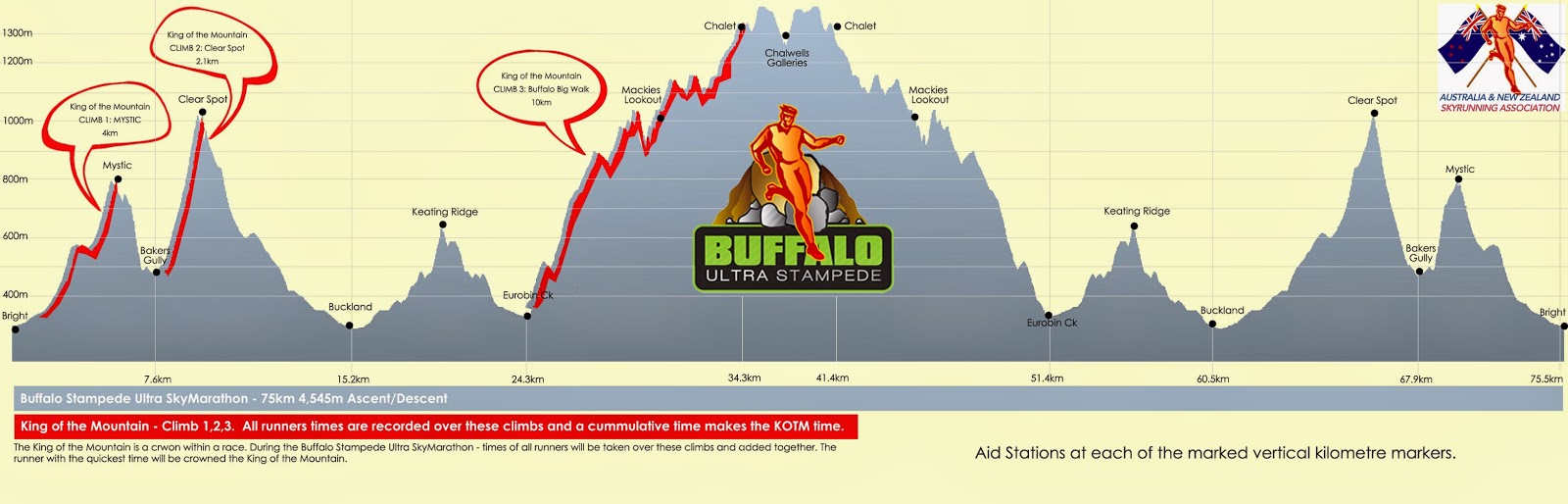
10:45am, 24.4km. I start the Big Walk - a 10km climb up the side of Mount Buffalo. My race plan is to take it slow and not get caught up in the KOM competition that times your performance from the bottom to the top and back again. A 10km climb is something very new to me and I want to enjoy it. 

10:40am, 24.4km. The descent from Keating Ridge was uneventful and I arrive at the Eurobin aid station at the foot of Mount Buffalo. I exchange my bottles for a 1.5L bladder, have a quick chat to Paul and I'm off. I'm in 103rd place at this point (although I don't know this until after the results are published).  

9:49am, 17.9km. I enter the Mount Buffalo National Park to start the climb over Keating Ridge. I decide to walk almost from the start, ignoring the people running past me. "It's not about running through this section on the way out," I think to myself, "but I WILL be running through here on the way back."

9:32am, 15.5km. Through Buckland aid station. I take some pictures but they don't do the scenery justice. 


 Departing the Buckland Valley aid station

9:05am, 11.4km. I slip and slide down Warner's Wall, literally falling over three times, sticks flying. So embarrassing. I have red dirt stains everywhere - hands, legs, DTR singlet, shorts. Really looking forward to going up this at the 64km mark...

9:03am, 11.0km. I bump into DTR and SCTR regular Siqi on the way down from Clear Spot, who tells me the next few km are flat after the next descent. It's just that the next descent is the infamous "Warner's Wall"


Start of the descent from Clear Spot

8:49am, 9.3km. That climb up to Clear Spot just keeps... on... going. It takes 40 minutes for 1.8km. On its slopes I draw level with someone who asks me about my blog! My first brush with fame! (Delusions of grandeur? Moi?). His name is Garth and we chat for a bit, with me sharing the good news that my Suunto GPX file is telling me the top is only 300m away. Coming down this hill later on will be interesting, I think to myself,  but I'm pretty sure it won't be too bad. We get to the top and my support crew member Paul is there, with some more Tailwind ready to go


Early stages of the Clear Spot climb
(Photo credit: Aurora Images)


8:12am, 7.5km. Mick's Track finally over, I run past the aid station at Bakers Gully and prepare myself for the second climb: Clear Spot. The photographer perfectly captures my reaction upon seeing the climb:


First glimpse of Clear Spot
(Photo credit: Aurora Images) 


8:00am, 6.2km. This isn't a hill, it's a cliff face! Still, at least I'm keeping my feet, that's three people I've seen fall over, but at least I'm still uprigh... Oh. Never mind. 


The pros descending Mick's Track
(Photo credit: Franck Verez) 

7:56am, 6.0km. We have to go down THAT?!?! 

7:55am, 5.9km. I can see a turn-off ahead. That must be this "Mick's Track" that everyone talks about.

7:42am, 4.7km. We emerge from the trees and we're approaching the helipad at the top of Mystic. The first climb done! That actually wasn't so bad - not sure what the fuss is about, to be honest. I mean, if the other side of this hill is anything like this, it should be relatively easy to climb later on.

7:20am, 3.4km. The serious stuff starts. The climb to Mystic. The first of seven climbs. I settle into an easy rhythm and get out the sticks.

7:03am, 0.5km. I have a chat with my friend and runner extraordinare, Vanessa. We talk about how fast people are running. That's ok, we say - the goal is to be running fast at the end of 75kms, not at the start.

7:00am, 0.0km. Go!

6:59:57am. 3,2,1...

---------------------------------------------------------------------------------------------------------------

Suunto Movescount file: http://www.movescount.com/moves/move58806486